
A Response to Fairtax.org’s Tax Plan
November 1, 2026
America needs more than a different way to collect the same taxes. It needs a revenue system capable of honoring public commitments, reducing debt, and supporting its people through an economy increasingly shaped by automation and changing employment.
Having studied all the alternative tax plans we could find while researching The One Percent Solution, we believe FairTax advances an important debate but stops short of the opportunity before us.
FairTax concentrates taxation on final purchases of new goods and services. Our proposal includes those purchases at just 1%, while extending taxation across the much larger flow of covered business and financial transactions. Drawing on historical transaction data cited in our appendix, our expanded model identifies a potential annual base of $2.5 quadrillion. At a uniform 1%, that represents $25 trillion in potential gross annual revenue.
The central difference is the scale of economic activity each plan proposes to tax.
We support replacing the present federal income and payroll tax structure. But we do not believe FairTax has demonstrated that its proposed rate can adequately finance existing commitments while addressing national debt, household insecurity, and changes in the job market.
We are not socialists. Neither do we support the corporatism that allows politically connected interests to shape public policy for their own benefit. We favor free enterprise, private ownership, broad participation in funding public responsibilities, and a government that lives within its means.
A broader tax base offers the possibility of a much smaller contribution from each covered transaction while producing substantially greater public resources.
The basic differences
FairTax’s stated rate is 23% of the total tax-inclusive purchase price, equivalent to approximately 29.87% of the pretax price. Its family consumption allowance, or prebate, is intended to offset taxes on poverty-level spending. Its collection mechanism differs from a value-added tax, often called IVA in European and Spanish-speaking countries, but both approaches make consumption central to their tax bases. [1,2]
FairTax vs. The One Percent Solution
A side-by-side comparison of the two tax proposals across five features: tax base, tax rate, collection method, revenue foundation, and fiscal purpose.
| Feature | FairTax | The One Percent Solution |
| Tax base | Final purchases of taxable new goods and services, including eligible government purchases | Covered consumer, business, and financial transactions |
| Tax rate | 23% of the tax-inclusive price — equivalent to 29.87% of the pretax price | 1% general transaction tax; 0.5% investment outflow tax |
| Collection method | Sellers collect and remit through administering authorities | Automatic collection through payment and settlement systems |
| Revenue foundation | Final consumption | A broader base of commercial and financial transactions |
| Fiscal purpose | Replace federal income, payroll, estate, and gift taxes | Replace specified existing taxes, fund public commitments, retire debt, and build sovereign assets |
Tax rates at a glance
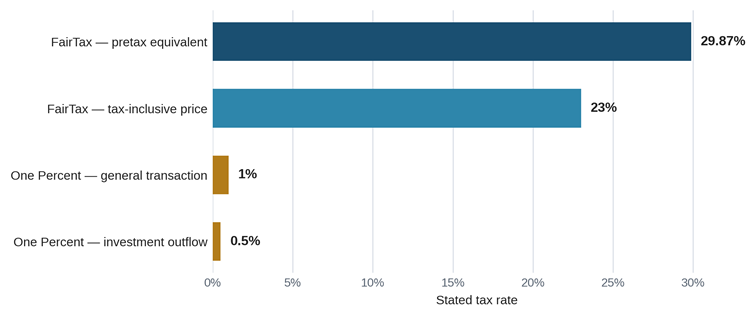
The bars compare the stated rates only. The two proposals apply those rates to different tax bases — final purchases under FairTax, and a broader set of covered transactions under The One Percent Solution — so the chart does not by itself compare total tax burden.
Comparison table — FairTax and The One Percent Solution, as described in the source data provided.
A purchase taxed under FairTax would fall within our general transaction base at 1%. Our revenue would also come from covered activity beyond the checkout counter: business payments, wholesale finance, securities settlement, and other eligible financial flows.
What the revenue figures show
A published analysis by William Gale and Kyle Pomerleau provides a basis for estimating FairTax’s revenues beyond retail sales alone. Using their 2023 study’s projections for 2026, we calculate approximately $5.17 trillion in gross annual collections and $4.26 trillion after household prebates, assuming full collection. Applying the study’s 17% private-sector evasion and avoidance assumption reduces the amount after prebates to approximately $3.51 trillion. [3]
These are calculations from that study’s assumptions, not FairTax’s own forecast or an updated 2026 revenue estimate. They also do not establish a complete allowance for collection expenses. Tax receipts from federal purchases must be considered alongside the corresponding cost to the government.
Our book presents three transaction-base scenarios:
Revenue Scenarios at a Uniform 1%
Potential gross revenue under three modeled annual transaction bases, each taxed at a uniform 1%.
| Scenario | Modeled annual transaction base | Potential gross revenue at a uniform 1% |
| Conservative | $700 trillion | $7 trillion |
| Expanded | $2.5 quadrillion | $25 trillion |
| Comprehensive | $5 quadrillion | $50 trillion |
Potential gross revenue at a glance
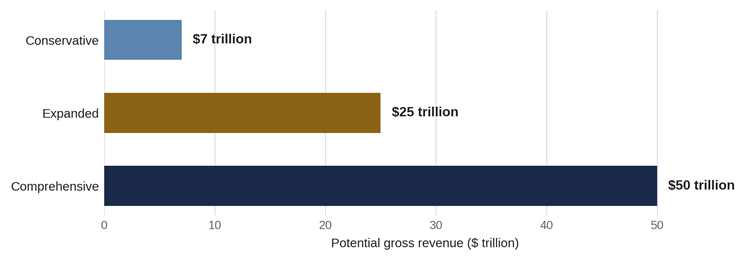
Each revenue figure is 1% of its scenario’s modeled annual transaction base: $700 trillion, $2.5 quadrillion, and $5 quadrillion respectively.
Revenue scenarios table, as described in the source data provided.
One quadrillion dollars equals one thousand trillion dollars. One percent of one quadrillion is $10 trillion. That scale explains why a low rate across a broad base deserves serious consideration.
The appendix’s historical transaction sources provide the foundation for our scenarios. To produce a final forecast, those figures must be reconciled with the separate 0.5% investment outflow rate, exclusions, net settlement, overlapping flows, and changes in behavior. Derivative notional values are not cash payments and should not be counted as though they were.
The comparison is therefore between FairTax’s published consumption-tax estimates and our historically grounded transaction-base scenarios. Neither proposal has produced actual collections under an enacted system. Both require validation of their assumptions about taxable activity, compliance, economic responses, and collection costs.
The potential financial difference remains substantial. Under our expanded uniform-rate illustration, every $1 trillion allocated to a public purpose represents 4% of gross revenue. An illustrative $10 trillion program budget would leave $15 trillion before collection costs and other obligations. This is an illustration of fiscal capacity, not a completed spending forecast.
Our objective is to finance Social Security, healthcare, education, defense, and income security, then direct available surpluses toward debt retirement and the Sovereign Wealth Fund of the People.
Collecting the money when it moves
Revenue depends on both the taxable base and the collection process.
Under the introduced FairTax bill, the general payment deadline is the fifteenth of the following month, while large sellers remit weekly. Administering states generally have up to five days after receipt to forward funds. The bill also provides compensation for seller and state administration. [2]
A customer paying the tax therefore does not necessarily mean the Treasury receives it at that moment. Businesses must account for public funds, safeguard them, and transfer them later. Errors, delayed payments, and business failures remain collection risks.
Our proposal would allocate the tax as a covered payment settles and route it to designated public accounts. Merchants would receive their proceeds without separately holding the federal tax for a later remittance deadline.
Existing payment infrastructure provides a starting point, although implementation would require technical changes and safeguards. Collection at settlement could remove much of the separate merchant reporting and remittance burden. Payment records would remain necessary for verification, refunds, and corrections, with enforceable privacy protections.
Revenue when the economy contracts
A recession makes the choice of tax base more consequential. If taxable consumption falls 20%, gross revenue from that base also falls 20% at an unchanged rate, before other changes. Public needs can rise at the same time.
Business and financial transactions can continue even as households postpone purchases. A broader base would draw on more of that activity. It would not make revenue recession-proof: financial flows can also contract sharply. The case is for diversification supported by reserves.
For scale, a hypothetical 20% decline in our expanded $2.5 quadrillion base would leave $2 quadrillion. At a uniform 1%, that would yield $20 trillion rather than $25 trillion. This is a sensitivity illustration, not a prediction, and depends on validating the eligible base.
Revenue needs enforceable limits on spending
Greater revenue alone cannot ensure responsible government.
Our proposal couples transaction taxation with the Sovereign Wealth Fund of the People, designed to operate independently of day-to-day political control, with constitutional protection, transparent accounts, and enforceable allocation rules. Those protections would need to be established through the appropriate legal and constitutional processes.
Without durable spending limits, either tax system could become another source of funds for expanding political commitments. Our goal is to establish a structure that honors public obligations, prevents deficit spending under its governing rules, retires debt, and builds assets for future generations.
Sovereign investment would turn designated surpluses into public wealth. Returns would vary, so spending commitments should rest on available resources and prudent reserves.
We believe fairness requires considering the whole economy, the taxes being removed, and the transaction taxes being paid—including costs passed through successive business payments. The test is the resulting burden on Americans and the public benefits the system can reliably sustain.
FairTax has helped advance the debate over replacing the income tax. We believe the next step is to examine the broader eligible transaction economy.
Which approach can reliably produce the greatest public benefit with the lowest burden on Americans?
Our research makes a strong case for a much broader base at a much lower rate, with the potential to fund public commitments, retire debt, and build sovereign assets on a substantially greater scale.
We invite FairTax advocates, economists, policymakers, and citizens to examine both proposals using historical transaction records, government revenue and expenditure reports, and openly stated assumptions. Apply the same scrutiny to both plans and compare what each could deliver.
Edward Thurston, author of The One Percent Solution
www.theonepercentsolution.com
Sources and modeling basis
- FairTax, “The Chairman’s Report October 29th, 2026”.
- H.R. 25, FairTax Act of 2025, introduced January 3, 2025, particularly proposed sections 101, 204, 301, 401, and 501.
- William G. Gale and Kyle Pomerleau, “Deconstructing the Fair Tax,” March 27, 2023, Table 1 and Appendix Table A5. Calculations use its 2026 projections: $22.491 trillion × 23% = $5.173 trillion gross; less $0.912 trillion in prebates = $4.261 trillion; less approximately $0.753 trillion under its private-sector compliance-loss assumption = $3.508 trillion.
- The One Percent Solution, “Building a Broader Base: The Flow Economy,” FAQ question 4, and appendix transaction-volume sources. The $7 trillion, $25 trillion, and $50 trillion figures are uniform-rate arithmetic yields on the book’s modeled bases. The final mixed-rate forecast requires the adjustments described above.